
Read The Latest News From Us
Introduction to Bearings

Read The Latest News From Us
Bearing failure analysis is a vital component of systems engineering aimed at improving the reliability of working surfaces.
Bearings (whose operational functions are compromised when they fail or cease to function as intended) are subject to failure phenomena known as ' bearing failure'. These failures can be categorised into two types: failures occurring within the normal service life and premature failures. This study focuses primarily on the causes of premature bearing failure resulting from pitting and fatigue, analysing these factors and proposing recommendations to enhance the service life and reliability of rolling bearings.
Fatigue failure in rolling bearings is a form of surface failure, primarily characterised by the initiation, propagation and fracture of fatigue cracks, resulting from the long-term effects of alternating loads on the metal.
Rolling bearings utilising cages manufactured from glass fibre-reinforced Nylon 66 are suitable for stable operating conditions where temperatures do not exceed 120°C. When these bearings are lubricated with oil, the presence of additives in the oil may lead to a reduction in the service life of the cage. When temperatures exceed 120C, aged lubricating oil will also shorten the service life of the cage. Therefore, careful monitoring and timely replacement of the lubricating oil are essential.
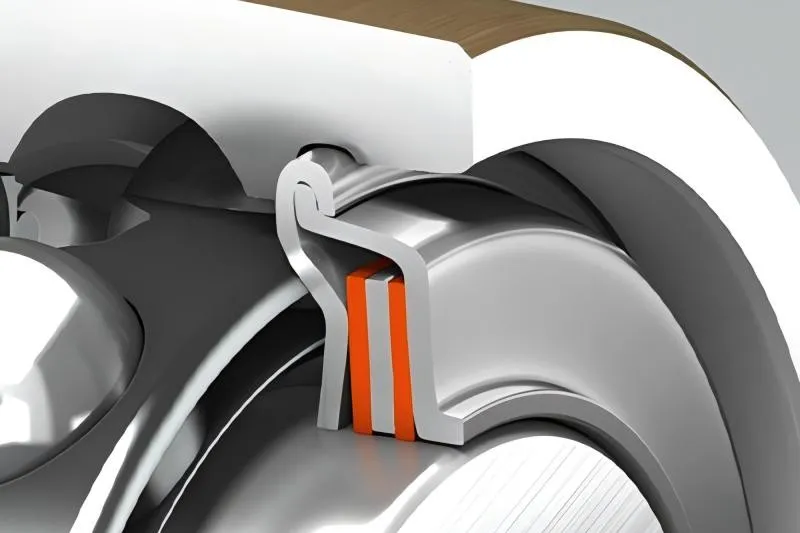
Sealed rolling bearings are lubricated with high-quality, specially tested lithium-based grease. This grease can withstand high temperatures of up to 120°C for short periods. If the steady-state operating temperature reaches 70°C or higher, the service life of standard lithium-based grease will be reduced. For frequent operation at high temperatures, special grease must be used, andconsideration must also be given to whether heat-resistant materials are required for the sealing arrangement. The operating temperature for standard contact seals must not exceed 110°C. If high-temperature synthetic materials are used for sealing, it must be borne in mind that these highly effective fluorinated materials release gases and fumes harmful to health at temperatures exceeding 300°C. Particular care must be taken in this regard when using a blowtorch to remove rolling bearings.
1. Rolling bearings have a much lower load-carrying capacity than sliding bearings of the same size; consequently, their radial dimensions are larger. Therefore, sliding bearings are often preferred in applications involving heavy loads or where compact radial dimensions and a compact design are required.
2. Rolling bearings generate significant vibration and noise, which becomes particularly noticeable during the later stages of use.
Consequently, in applications where high precision is required and vibration is unacceptable, sliding bearings generally provide a superior solution.
3. Rolling bearings are particularly sensitive to foreign matter such as metal shavings; once contaminants enter, they can cause intermittent, significant vibration and noise, which can easily lead to damage. Consequently, the service life of rolling bearings is limited. In summary, the service life of rolling bearings is generally shorter than that of sliding bearings.